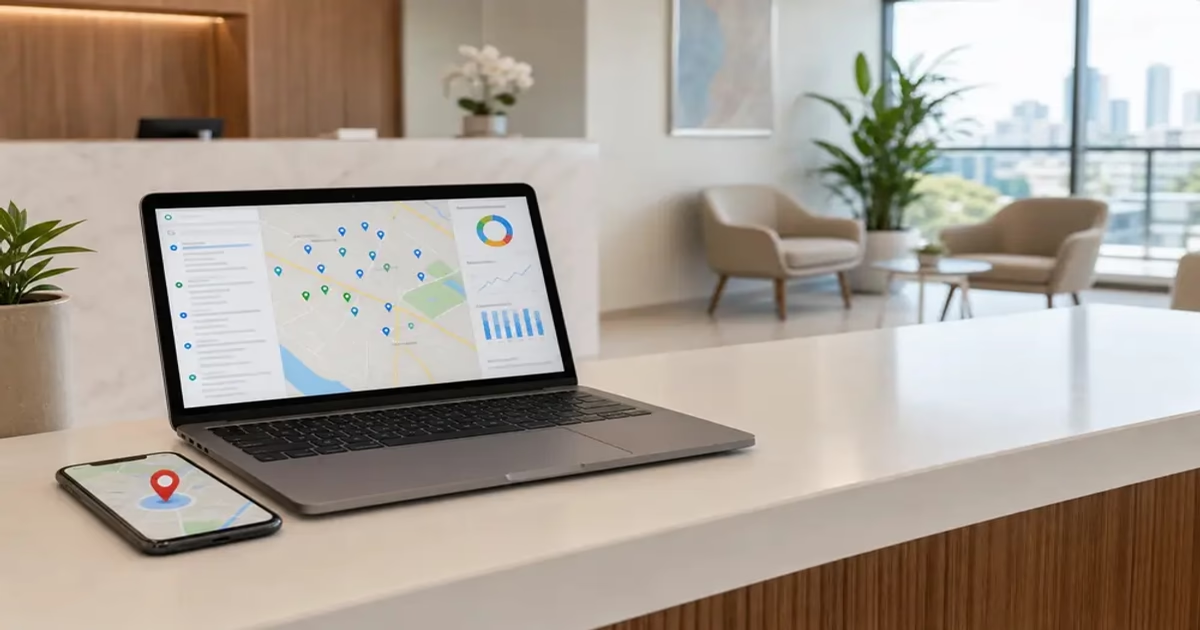
SEO for service businesses in Londrina is the process of being found by people already looking for a local solution and turning that visibility into qualified quote requests. For clinics, construction companies, real estate firms, law offices, technical services and B2B providers, the goal is not traffic for its own sake. The goal is demand from people who have a problem, a location and a reason to contact the business.
A strong strategy combines service pages, local SEO, helpful content, reputation, technical SEO and conversion paths. A business that wants to compete in Londrina needs to make clear what it does, where it serves, why it is credible and how the customer can take the next step. That is where SEO for businesses becomes a demand system, not just a keyword list.
Local context matters. The IBGE city profile positions Londrina as one of the main municipalities in Paraná. In a market like that, customers compare providers through Google, Maps, reviews, websites and contact options before sending a request.

Direct answer: how does SEO generate quote requests?
SEO generates quote requests when the business appears for searches with commercial intent, answers key questions before the first contact and makes conversion easy. That requires specific service pages, a clear site architecture, consistent local information, trust signals and visible calls to action.
The common mistake is treating SEO as traffic. Traffic alone does not pay the bills. For service companies, the right visitors are people who need a solution, trust the provider and know how to contact the business.
Why service businesses depend on local search
Services are bought with trust. A customer usually does not choose the first result without comparison. They read reviews, check whether the provider serves their area, visit the website, compare services and evaluate whether the business looks reliable.
This happens in searches such as “SEO agency in Londrina”, “dentist near me”, “construction company in Londrina” or “technical maintenance provider near me”. Each query carries a different level of intent. Some educate. Others show readiness to contact a provider.
A good strategy separates those intents. Educational content builds authority. Service pages capture demand. Local pages and business profiles help the customer understand proximity and relevance.
Showing up is not the same as generating demand
A company can receive impressions without contacts. It can get clicks without quote requests. It can generate forms that do not match its ideal customer. This is why SEO for service businesses must connect visibility, persuasion and conversion.
Visibility answers whether the business can be found. Persuasion answers whether the content builds trust. Conversion answers whether the user can easily take action through WhatsApp, phone, form or another channel.
What should be ready before investing in SEO?
The website should load well, work on mobile, explain core services, show contact options and present a clear service area. A nice but vague website wastes local traffic.
The Google Business Profile should also be reviewed. Google explains that local ranking is based mainly on relevance, distance and prominence. This means complete data, accurate categories, reviews and public consistency matter.
Measurement is another foundation. If the company does not track calls, forms, WhatsApp clicks and lead quality, it may confuse traffic growth with business growth.
The role of Google Business Profile, service pages and content
The Google Business Profile helps the business appear in Maps, calls, directions and local panels. The website supports deeper evaluation. Service pages explain solutions, process, proof and next steps. Blog content helps answer questions that appear before the budget conversation.
When these assets reinforce each other, the customer sees consistency. The business name, service area, contact details, services and positioning match across the profile, the website and other public signals.
Content that creates demand
Useful content for service companies should answer buying questions: when to hire, what affects price, how to compare providers, what risks to avoid and what signs indicate a good service. Google Search Central recommends creating helpful, reliable, people-first content. For service businesses, that means content that supports a better decision.
On mobile, swipe the table sideways to see all columns.
| Action | Expected impact | Typical timing | Risk if ignored |
|---|---|---|---|
| Structure service pages | Helps Google and buyers understand what the business offers | Short to medium term | The site gets broad visits but few qualified requests |
| Optimize the Google Business Profile | Improves Maps visibility, calls, route requests and local discovery | Short term for basic fixes | Competitors look more complete and trustworthy |
| Create content around real questions | Reaches buyers before they compare providers | Medium term | The site depends only on highly competitive commercial terms |
| Build reviews and social proof | Increases trust before the first contact | Ongoing | Users choose the business that looks more credible |
| Track calls, forms and WhatsApp | Shows whether SEO creates commercial opportunities | Immediately after setup | The company measures traffic but not demand |
Common mistakes
The first mistake is using one generic page for every service. That makes it harder for Google and customers to understand relevance. The second mistake is depending only on the Google Business Profile. The profile helps discovery, but the website builds depth, proof and conversion.
The third mistake is publishing generic content copied from competitors. This does not create differentiation. The fourth mistake is measuring only rankings, without connecting organic search to calls, forms and quote quality.
How to measure real opportunities
The most important metric is not sessions. It is commercial opportunity. Track calls, forms, WhatsApp clicks, route requests, branded searches, pages viewed before contact and the quality of each request.
Also separate leads by intent. A person coming from a service page is usually closer to action than someone who arrived through an educational article. Both are useful, but they play different roles.
When should a business hire an SEO agency?
Hiring an agency makes sense when the company knows organic search can generate demand but lacks the method, time or team to execute. It also makes sense when the website has technical issues, weak service pages, inconsistent local signals or strong competitors.
For companies in Londrina, an agency should connect technical SEO, local SEO, content, Google Business Profile and conversion. The decision should consider diagnosis, transparency, content quality and the ability to measure commercial outcomes.
Final checklist
- Does the website have specific pages for the main services?
- Do service pages explain problem, solution, process and next step?
- Is the Google Business Profile complete and updated?
- Are phone, address, hours and links consistent?
- Are reviews real, recent and answered?
- Does the website work well on mobile?
- Are service pages, blog posts and contact pages connected by internal links?
- Does content answer questions that appear before a quote request?
- Are WhatsApp clicks, calls and forms tracked?
- Is SEO connected to sales, not only traffic?
Conclusion
SEO for service businesses works best when it is treated as a demand generation system. Visibility is only the first step. Trust, clarity, content, reputation and conversion turn local search into business opportunities.
If your company depends on local quote requests, LondrinaSEO can review your website, local SEO and conversion points.
How to plan the first 90 days of SEO for a service business
A service business should not start local SEO by publishing random articles. The first 90 days should be used to fix the commercial foundation, because every later content piece depends on that structure. In the first month, review the website, the most important services, the Google Business Profile, tracking, contact forms and mobile experience. The goal is to remove friction before traffic increases.
In the second month, build or improve pages for the services that already generate revenue. Each page should explain who the service is for, which problem it solves, how the process works, what the customer should prepare before contacting the company and what makes the provider credible. This is also the right moment to connect the page with internal links from the homepage, blog posts, local pages and contact areas.
In the third month, start content around decision questions. Instead of writing only broad educational articles, prioritize topics that help the customer compare options: how to choose a provider, what affects the budget, which warning signs to avoid and what information is needed for a better quote. This type of content usually attracts fewer casual readers, but it supports stronger commercial intent.
Why local SEO must work with sales and customer service
SEO does not end when the user lands on the website. If the WhatsApp answer is slow, if the form asks for too much information, if the phone is not answered or if the sales team does not know which page generated the lead, part of the SEO value is lost. For service businesses, organic search and sales operations need to share information.
The company should review the questions that leads ask after finding the site. If many people ask the same thing, that question may deserve a better section on a service page or a dedicated article. If leads often request services outside the business scope, the page may need clearer qualification. If good leads come from one specific article, that topic can become a stronger internal link hub.
This feedback loop is what turns SEO into a business process. Rankings matter, but the real advantage comes from understanding which searches create profitable conversations and improving the website around those conversations.
Frequently Asked Questions
Does SEO work for local service businesses?
Yes, when it connects service pages, local intent, Google Business Profile, useful content and real conversion tracking.
What is the difference between local SEO and general SEO?
Local SEO focuses on regional intent, Maps visibility, reviews, consistent business data and searches with local modifiers.
How long does SEO take to generate quote requests?
It depends on competition, website quality and execution. Local fixes may show earlier signals, while authority and content usually compound over months.
Do I need a website if I already have a Google Business Profile?
Yes. The profile supports discovery, but the website explains services, proof, process and conversion paths.
What should a service business measure?
Calls, forms, WhatsApp clicks, route requests, branded searches, converting pages and the quality of received quote requests.